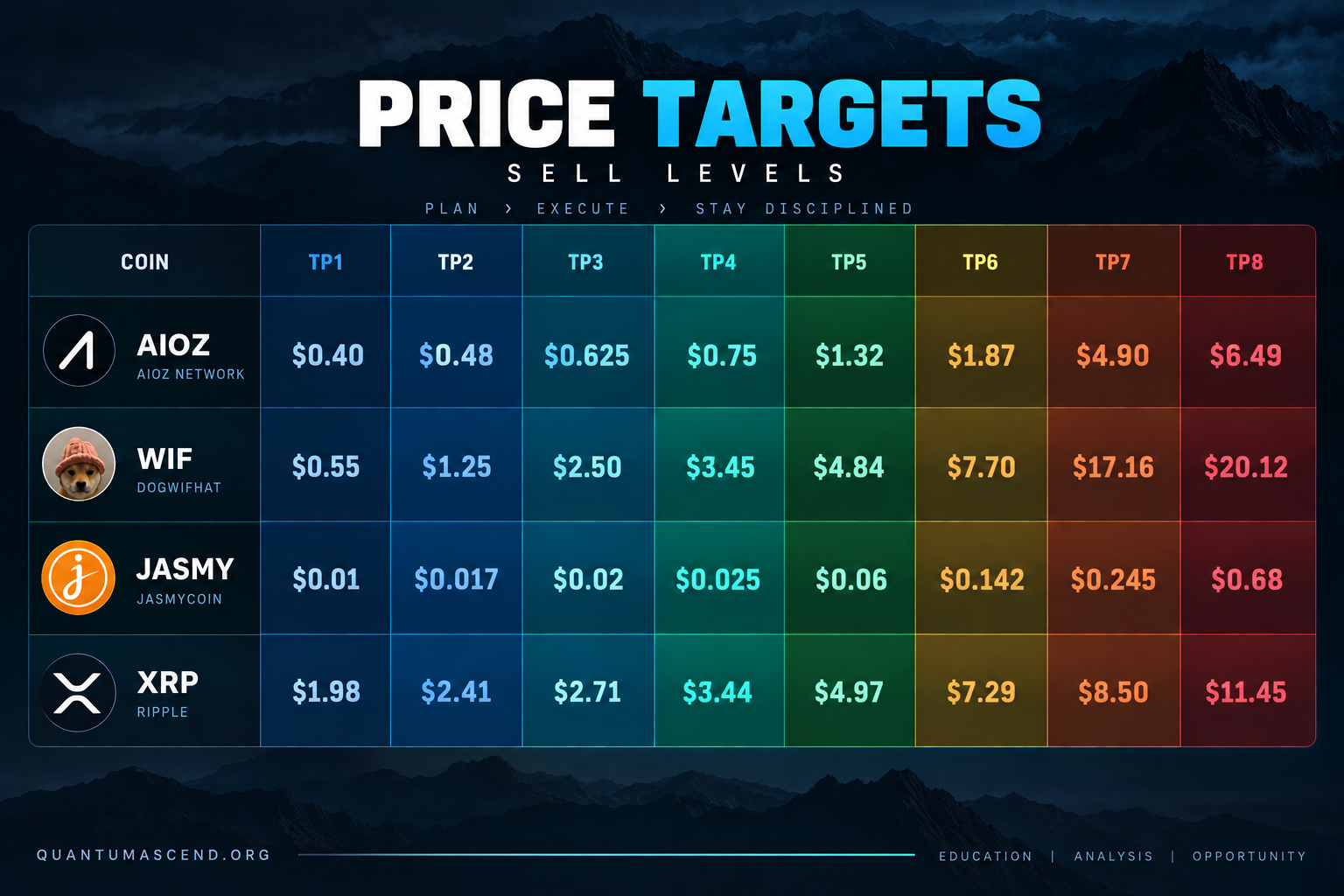
Thesis & Targets:
Executive Summary
Our core thesis remains bullish: Bitcoin appears to be approaching the conclusion of its corrective structure, the broader liquidity expansion cycle continues to support our macroeconomic outlook, and altcoins may be positioned for a significant period of relative outperformance.
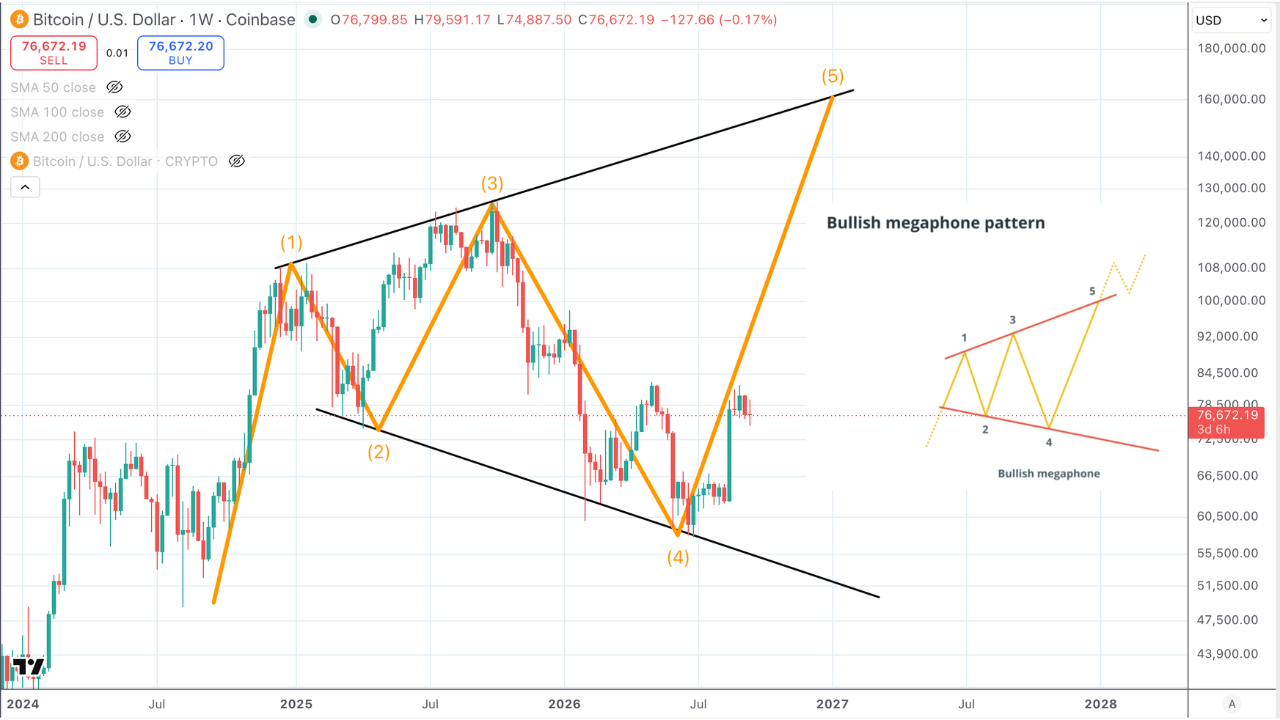
Our primary Bitcoin upside target remains approximately $160,000, supported by our interpretation of its long-term bullish megaphone structure.
However, the opportunity we are most focused on is not necessarily Bitcoin itself. It is the potential for capital to rotate into altcoins as the liquidity cycle matures and investors move further out on the risk spectrum.
We believe several developments support this outlook:
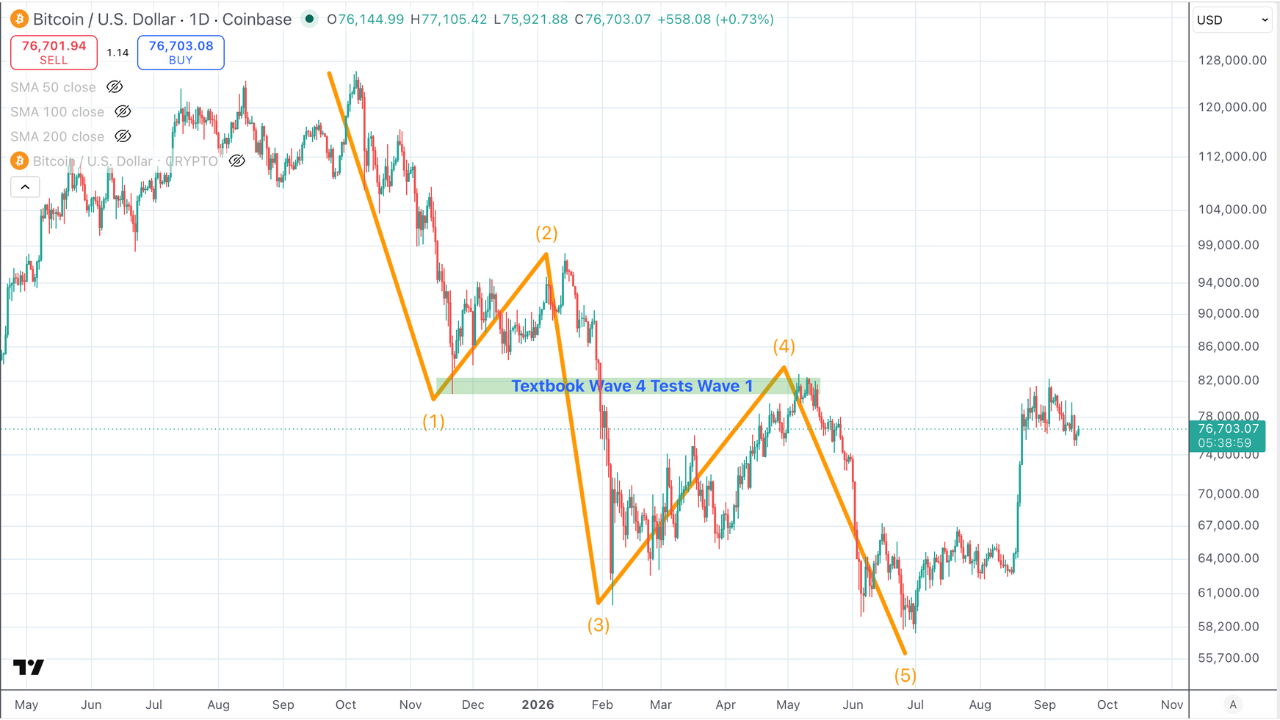
Bitcoin's five-wave corrective decline appears complete, while on-chain indicators suggest a potential market bottom.
The liquidity expansion sequence continues to align with our broader macro framework.
Crypto has meaningfully diverged from equities, creating the potential for a relative catch-up move.
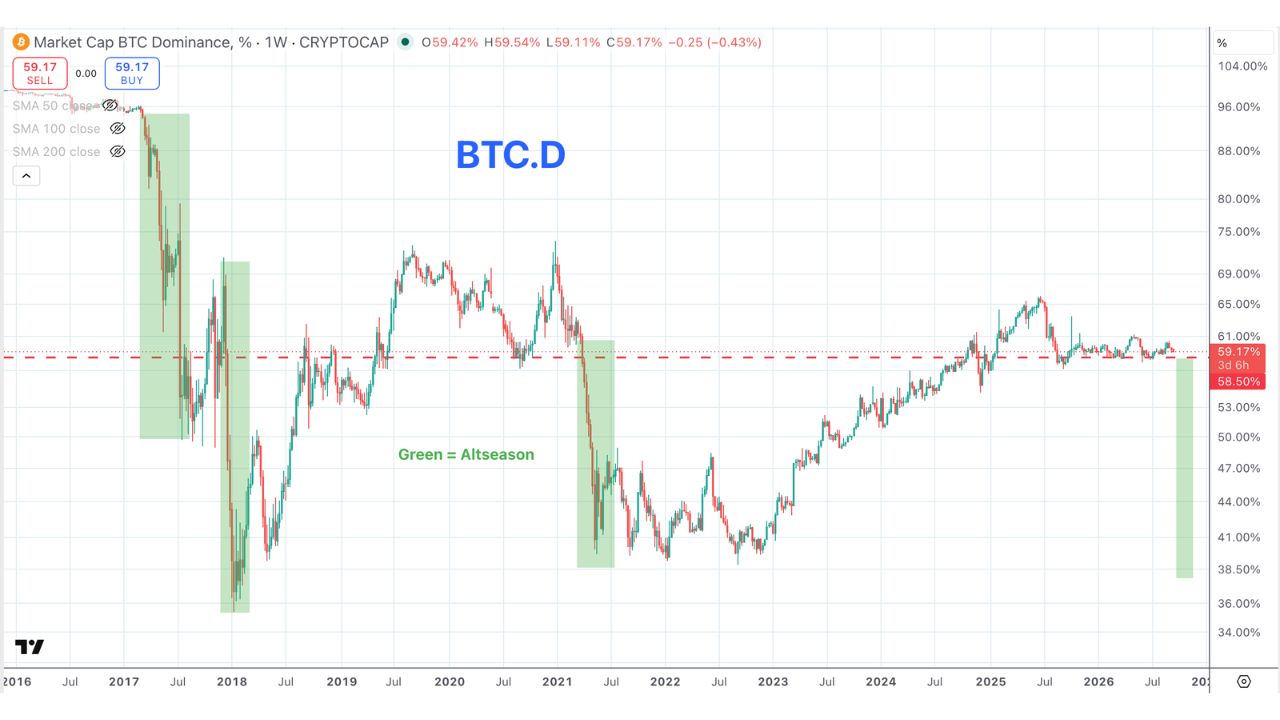
Bitcoin dominance is testing the critical 58.5% region, which could become an important confirmation signal for altcoin outperformance.
Our dollar-cost averaging strategy has allowed us to accumulate positions throughout the correction, potentially positioning the portfolio to benefit even if altcoins experience only a partial recovery.
Our base case is that altcoins will outperform Bitcoin during the next meaningful advance. Whether that develops into a full-scale altseason remains to be seen.
Importantly, our strategy is not simply to anticipate higher prices. It is to capitalize on the opportunity while progressively reducing risk as the market advances.
The objective is to turn accumulated positions into realized profits, not to hold indefinitely in pursuit of a perfect market top.
1. The Macro Foundation: Following the Liquidity Cycle
The foundation of our thesis remains the global liquidity cycle.
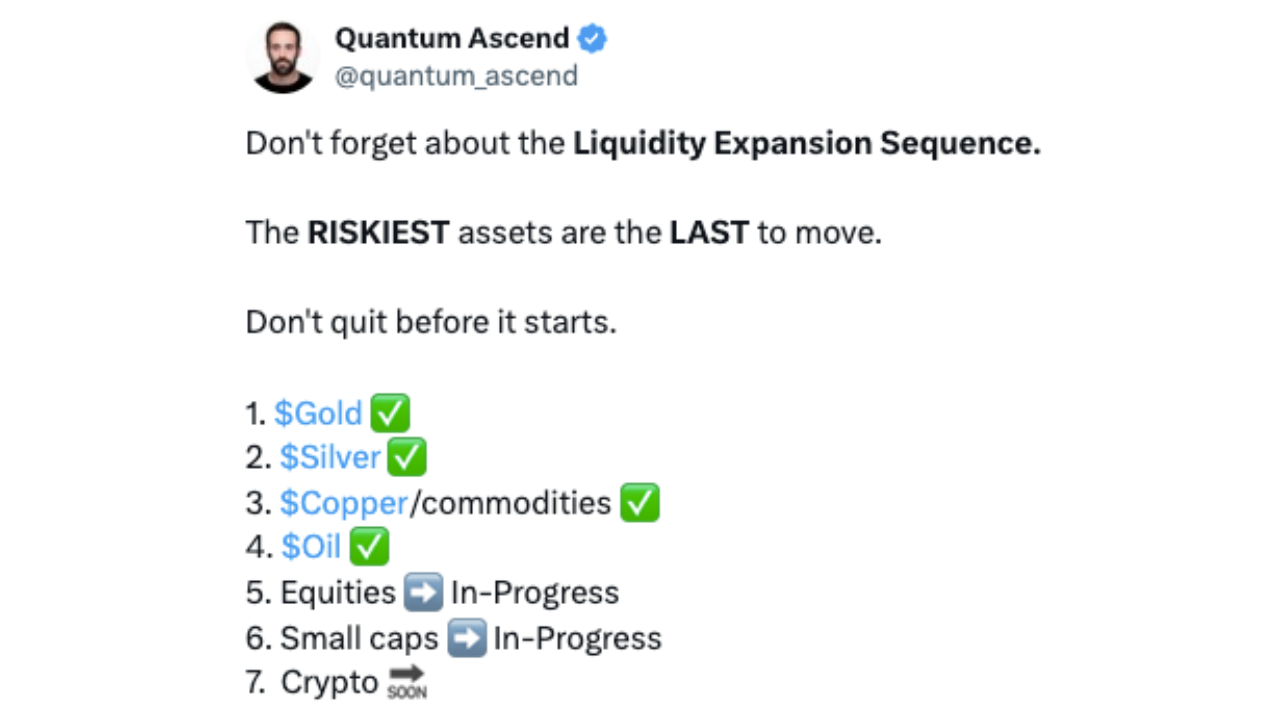
Throughout this market cycle, we have been tracking the sequence through which improving liquidity conditions can influence financial markets. Thus far, the broader progression has remained consistent with our expectations.
Liquidity does not necessarily flow into every asset class simultaneously.
As financial conditions improve and investors become increasingly comfortable taking risk, capital can gradually migrate from more established assets toward increasingly speculative opportunities.
The potential liquidity rotation
Illustrative sequence, not a fixed rule
01 Liquidity conditions improve
Financial conditions become more supportive of risk-taking.
02 Established risk assets respond
Capital initially concentrates in deeper, more liquid markets.
03 Bitcoin attracts capital
The largest and most liquid cryptocurrency can benefit from renewed demand.
04 Capital rotates into altcoins
Investors increasingly seek opportunities further out on the risk spectrum.
Crypto sits toward the speculative end of the global risk spectrum, with smaller-cap altcoins generally carrying even greater volatility and liquidity risk than Bitcoin.
This is why we have consistently emphasized that the riskiest assets may be among the last to participate in a broader liquidity-driven advance.
The absence of immediate altcoin outperformance does not automatically invalidate the liquidity thesis. It may instead indicate that capital has not yet rotated sufficiently far along the risk spectrum.
That distinction is central to our current positioning.
We believe the broader liquidity expansion sequence is still unfolding, and that altcoins may have substantial room to participate if the cycle continues.
2. The Crypto–Equity Divergence: A Potential Catch-Up Opportunity
One of the more interesting developments in this cycle has been the divergence between cryptocurrency and the broader equity market.
Historically, there have been periods when crypto has substantially underperformed equities before subsequently closing part of that performance gap.
Our interpretation is that the current divergence may represent a similar opportunity.
Rather than assuming that strong equity performance must eventually resolve through a major stock market decline, we believe an alternative scenario deserves serious consideration: crypto could begin catching up.
This is particularly relevant when viewed alongside our liquidity framework.
If liquidity conditions remain supportive and the broader appetite for risk persists, crypto's relative weakness could create an opportunity for capital to rotate into an asset class that has yet to participate fully.
However, this relationship is not guaranteed. Crypto can remain disconnected from equities for extended periods, and the divergence could also narrow through equity weakness or further crypto underperformance.
The important question is whether the broader macroeconomic backdrop continues to support risk-taking.
For now, our thesis favors a recovery in crypto's relative performance rather than assuming that equity markets must experience a significant correction.
3. October 10: A Major Disruption to the Cycle
We believe the events of October 10, 2025, are essential to understanding the current market structure.
The cryptocurrency market experienced an extraordinary liquidation event following the announcement of additional U.S. tariffs on China. Elevated leverage, deteriorating liquidity, and cascading forced selling amplified the initial shock.
In our view, this event materially disrupted the market's trajectory and contributed to the divergence between crypto and equities.
We suspect the severity of the event was not entirely organic and believe the possibility of coordinated market activity deserves scrutiny. However, orchestration has not been established. Published research documents liquidation feedback loops, while exchanges and industry participants have disputed the causes and extent of platform-specific failures.
Regardless of the ultimate explanation, the consequences were substantial.
The liquidation cascade forced market participants out of positions, damaged confidence, and created conditions in which cryptocurrency prices could become disconnected from the broader risk-asset environment.
Our interpretation is that the divergence might have been considerably smaller without this event.
That raises an important possibility: some of the subsequent weakness may reflect the lingering effects of a market-structure shock rather than a complete deterioration in the underlying macroeconomic thesis.
This does not mean that the market is obligated to recover its losses. It does, however, provide context for why we are reluctant to interpret crypto's relative weakness as definitive evidence that the broader cycle has ended.
4. Macro Headwinds: Markets Have Shown Some Resilience
Two developments have introduced additional uncertainty into the cryptocurrency outlook: the absence of enacted CLARITY Act legislation and renewed interest rate increases.
The CLARITY Act's failure to advance in the Senate and the Federal Reserve's September 16 quarter-point rate hike have created potential headwinds. Bitcoin's immediate reaction to the rate decision was relatively contained, although prices have remained volatile around policy developments.
What stands out to us is that these developments have not, by themselves, produced the kind of sustained market deterioration that might be expected under a more fragile market structure.
We interpret this as a potentially constructive sign of resilience.
It is important, however, to distinguish between the market absorbing a known event and the market becoming immune to further negative developments.
Additional tightening, persistently elevated yields, or a deterioration in financial conditions could still undermine the liquidity thesis.
Similarly, regulatory uncertainty remains relevant even if the market has already incorporated some of that uncertainty into prices.
Our focus is therefore on how the market behaves in response to adverse developments, rather than assuming that any single policy decision determines the direction of the entire cycle.
The ability to stabilize and recover despite macroeconomic headwinds would strengthen our conviction that the underlying market structure is improving.
5. Bitcoin: The Technical Structure Supports a Potential Recovery
With the macroeconomic foundation established, the next question is whether Bitcoin's technical structure supports the same conclusion.
Our analysis suggests that it does.
The bullish megaphone structure
Bitcoin appears to be developing within a long-term bullish megaphone, also known as a broadening formation.
This structure is characterized by expanding price swings, with progressively wider boundaries containing the market's movements.
Our interpretation is that Bitcoin's recent correction may represent another major swing within this broader formation rather than the definitive end of the cycle.
If the structure continues to develop as anticipated, our primary upside objective remains the $160,000 region.
This target represents our technical projection, not a guaranteed destination. Its validity depends on Bitcoin maintaining the structural conditions that support the pattern.
The five-wave correction appears complete
On a shorter time frame, our Elliott Wave analysis suggests that Bitcoin has completed a five-wave decline.
If that interpretation is correct, the market may be transitioning away from its corrective phase and into a recovery.
The completion of a five-wave decline does not automatically guarantee a new impulsive bull market. It can also precede a temporary corrective rebound.
For that reason, we want to see price action confirm the count through sustained strength, higher highs, higher lows, and the recovery of important resistance levels.
Nevertheless, the apparent completion of the decline aligns with our broader expectation that Bitcoin should begin moving higher.
On-chain indicators reinforce the bottoming thesis
Our interpretation of Bitcoin's on-chain metrics provides another layer of support for the possibility that a meaningful bottom has formed.
On-chain analysis allows us to evaluate market behavior beyond price alone, including investor positioning, realized profitability, and the behavior of different holder cohorts.
When multiple independent indicators begin pointing toward exhaustion of selling pressure, they can strengthen the case for a developing bottom.
Our current assessment is that the on-chain picture is consistent with this possibility.
However, no single indicator can establish that the bottom is definitively in. We want to see the on-chain evidence remain constructive alongside improving technical structure and price action.
Taken together, the megaphone structure, apparent completion of the five-wave decline, and our on-chain assessment form the technical foundation of our Bitcoin recovery thesis.
The next step is determining whether that recovery translates into broader altcoin outperformance.
6. Bitcoin Dominance: The Key to Unlocking Altcoin Outperformance
While Bitcoin's price structure is important, Bitcoin dominance may be even more consequential for our portfolio.
Bitcoin dominance (BTC.D) measures Bitcoin's share of the total cryptocurrency market capitalization.
When dominance rises, Bitcoin is gaining market share relative to the rest of the cryptocurrency market. When it falls, capital is gaining exposure to cryptocurrencies outside Bitcoin, at least in relative market-capitalization terms.
Our primary level of interest remains 58.5%.
Bitcoin dominance has repeatedly interacted with this region over an extended period. The level has also been identified by other market observers as an important boundary within the broader dominance range.
We believe a sustained breakdown below this level could represent a meaningful shift in market leadership.
The longer a market spends testing an important level, the more attention a decisive resolution can attract.
After approximately a year of interaction with this region, a sustained breakdown accompanied by momentum would be particularly noteworthy.
If Bitcoin dominance loses 58.5% and fails to reclaim it, we would interpret that as an important confirmation of the altcoin rotation thesis.
However, a dominance breakdown alone is insufficient. Dominance can fall during a broad crypto selloff if Bitcoin declines faster than altcoins.
The strongest confirmation would therefore involve three developments occurring together:
Bitcoin maintains a constructive price structure
BTC.D breaks and holds below 58.5%
Altcoin market capitalization and alt/BTC pairs strengthen
That combination would provide considerably stronger evidence of genuine capital rotation than a dominance breakdown in isolation.
If these conditions develop, we believe altcoins could experience a substantial acceleration in performance.
Altcoin outperformance versus a full-blown altseason
It is important to distinguish between these two outcomes.
Our base case is that altcoins outperform Bitcoin during the next meaningful market advance.
That does not necessarily mean every altcoin will experience explosive gains or that the market will repeat the speculative conditions of previous cycles.
A full-blown altseason would require broader participation, sustained relative strength, and a more pronounced expansion in speculative appetite.
We believe that outcome is possible, but we are not making it a prerequisite for our investment strategy to succeed.
Even a more modest recovery could create meaningful opportunities in assets that have experienced substantial corrections.
7. Why Our Dollar-Cost Averaging Strategy Matters
Throughout the correction, we have continued to focus on accumulating positions at prices we believe offer attractive potential upside relative to our targets.
The purpose of dollar-cost averaging is to reduce dependence on identifying a precise market bottom.
By building positions across multiple price levels, we have sought to improve our average entry prices while maintaining exposure to a potential recovery.
This is particularly relevant to our altcoin thesis.
We do not necessarily need every asset to return to its previous all-time high for our accumulated positions to generate attractive returns.
In some cases, a meaningful retracement of the preceding decline may be sufficient to reach important profit-taking levels.
Consider an illustrative example:
HYPOTHETICAL POSITION
Previous high
$10.00
Average entry
$2.00
Recovery price
$4.00
Unrealized return
+100%
In this example, the asset remains 60% below its previous high, yet a position accumulated at $2 has doubled in value. This excludes fees and taxes and assumes the average entry reflects the full position cost.
This illustrates why our strategy does not depend exclusively on an extraordinary altseason.
A recovery that falls short of previous cycle highs could still produce meaningful returns from favorable entry prices.
Of course, dollar-cost averaging does not eliminate risk. An asset can continue declining, fail to recover, or permanently lose value.
Our accumulation strategy must therefore remain connected to the underlying investment thesis and our broader risk management framework.
The goal is not to average down indefinitely.
It is to accumulate selectively when we believe the potential reward justifies the risk, and then capitalize on the recovery if the market develops as anticipated.
8. Our Exit Strategy: Turning the Thesis Into Realized Profits
Identifying a potential market bottom is only one part of successful portfolio management.
The more important challenge is determining how to manage positions as the market advances.
Our strategy is to take profits systematically at predetermined technical levels while progressively protecting the portfolio against a meaningful reversal.
We do not intend to rely on identifying the exact top of the market.
Instead, we will use a combination of individual asset targets, Bitcoin's broader price structure, and changing market conditions to guide our decisions.
Individual asset profit targets
Each asset in our portfolio has its own technical structure and corresponding profit-taking levels.
As prices reach these levels, we will evaluate opportunities to reduce exposure and realize gains.
This approach allows us to respond to the performance of individual assets rather than assuming that every cryptocurrency will peak simultaneously.
Some positions may reach their targets early. Others may require more time, and some may never reach their projected levels.
Our exit strategy must account for those differences.
Portfolio Targets can be found at the bottom of this page.
Bitcoin as a broader market signal
In addition to individual asset targets, we will use Bitcoin's price action as a guide for managing portfolio-wide risk.
As Bitcoin approaches major resistance levels and ultimately our projected $160,000 region, we will reassess the risk-reward profile of the broader cryptocurrency market.
Bitcoin does not need to reach $160,000 for us to begin taking profits.
Likewise, we will not automatically liquidate every position simply because Bitcoin reaches that target.
Our decisions will depend on the technical structures of individual assets, the strength of the broader market, and the degree to which our thesis continues to play out.
Protecting gains as the market advances
As positions appreciate, our priority will gradually shift from accumulation toward capital preservation.
We intend to use a combination of partial profit-taking, stop-loss orders, and adjustments to our remaining exposure.
The objective is to avoid allowing substantial unrealized gains to disappear during a subsequent market reversal.
Stop-loss orders are not guarantees of execution at a specific price, particularly in volatile or illiquid altcoin markets. They are one component of our risk management process rather than a complete solution.
Our broader principle is straightforward:
The further the market advances, the more deliberate we must become about protecting the gains we have accumulated.
We want to participate in the upside without becoming dependent on the market continuing higher indefinitely.
9. Risks and Thesis Invalidation
Conviction in a bullish thesis does not mean ignoring developments that could prove it wrong.
Our outlook depends on several conditions remaining constructive. If those conditions deteriorate, we must be willing to reassess our expectations and positioning.
Key risks we are monitoring
01 Deteriorating liquidity conditions
A sustained contraction in global liquidity, tighter financial conditions, or additional monetary tightening could undermine the foundation of our bullish outlook.
02 Bitcoin's technical structure fails
A breakdown below the proposed five-wave low or the relevant megaphone support would require us to revisit our preferred technical interpretation.
03 Bitcoin dominance remains elevated
A sustained recovery in BTC.D above the 58.5% region, particularly alongside weak alt/BTC pairs, would challenge the timing of our altcoin outperformance thesis.
04 Crypto continues underperforming equities
A prolonged divergence accompanied by deteriorating market breadth and weaker liquidity would weaken the argument for an eventual catch-up move.
05 On-chain conditions deteriorate
Renewed selling pressure, weakening holder behavior, or the failure of bottoming indicators to hold would challenge our interpretation that a meaningful Bitcoin bottom has formed.
06 Altcoin recovery lacks broad participation
Bitcoin could recover without meaningful capital rotation into altcoins. A rally concentrated in a small number of assets would fall short of our broader altcoin thesis.
The most important distinction is between a temporary delay and genuine invalidation.
For example, Bitcoin dominance remaining above 58.5% would not necessarily invalidate our entire macro thesis. It could simply indicate that the anticipated altcoin rotation has not yet begun.
Conversely, a sustained deterioration in liquidity combined with a breakdown in Bitcoin's technical structure would represent a much more significant challenge to our outlook.
We will continue evaluating these developments collectively rather than relying on any single indicator.
Our goal is to remain flexible enough to respond when the evidence changes.
10. Final Thoughts: The Opportunity Ahead
Our thesis remains centered on the belief that the broader cryptocurrency cycle has not yet completed its upside potential.
Bitcoin's apparent corrective completion, its long-term bullish megaphone structure, our interpretation of the on-chain data, and the continuing liquidity expansion sequence all contribute to that outlook.
We believe the October 10 liquidation event materially disrupted the market's trajectory and contributed to the divergence between crypto and equities.
If the broader liquidity environment remains constructive, that divergence could eventually resolve through a meaningful cryptocurrency recovery.
Within that recovery, we believe altcoins offer the potential for significant relative outperformance.
Bitcoin dominance remains one of the most important indicators we are watching. A sustained breakdown below 58.5%, accompanied by improving altcoin market capitalization and relative strength, would provide meaningful confirmation that capital is rotating further out on the risk spectrum.
Our primary Bitcoin target remains approximately $160,000.
However, our investment strategy does not require Bitcoin to reach that level or a full-blown altseason to materialize.
The positions we have accumulated throughout the correction may offer meaningful opportunities even under a more modest recovery scenario.
The key will be executing our strategy as the market develops.
We have spent considerable time identifying opportunities, building positions, and navigating the correction.
As prices advance, our focus will increasingly shift toward realizing profits, reducing exposure at important technical levels, and protecting the capital we have worked to accumulate.
We remain constructive on the broader opportunity, but conviction must always be accompanied by discipline.
Our objective is not simply to be right about the direction of the market. It is to translate a sound thesis into realized returns while managing the risk of being wrong.
That remains the foundation of our approach at Quantum Ascend.